Wachau Valley Vineyards: Terraces, Wine Styles and the Estates Tours Visit
The Wachau grows its wine on stone terraces above the Danube, and it labels that wine in a way you will not see anywhere else. If you are choosing between Wachau Valley wine tours, start with what is in the glass and where each day pours it.
Terraces 250 metres above the Danube
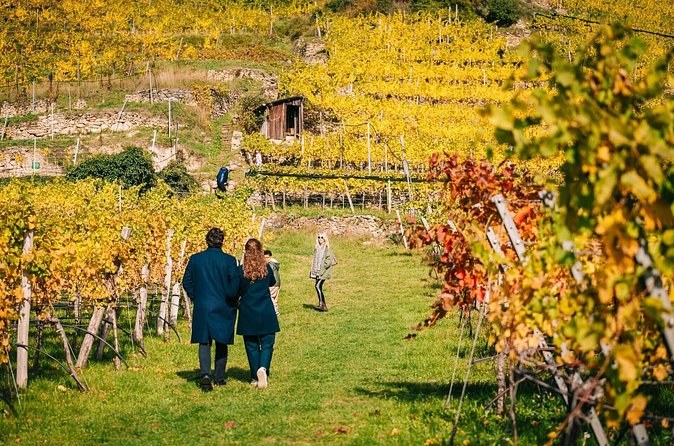
The Wachau is 33 km of river between Melk and Krems. Its vines climb terraces that reach about 450 m above sea level, which is 250 m above the Danube. Dry-stone walls hold the terraces up, and you see them from the road, the river and the trail.
Vinea Wachau puts the intensity of the wines down to the very modest yield per vine on these steep sites, so the terraces are what you are tasting. The association, based in Spitz, counts more than 200 member estates.
Steinfeder, Federspiel and Smaragd, by strength
These three names on a Wachau label tell you how light or powerful the wine is. All three are dry and white, made without oak, and come only from Wachau grapes. Steinfeder and Federspiel may also be rosé. The names are trademarks, so only member estates of Vinea Wachau use them.
| Style | Alcohol | Named after | What it is |
|---|---|---|---|
| Steinfeder | Up to 11.5% | Feather grass on the rocky terraces | Fragrant and light |
| Federspiel | Not more than 12.5% | The lure that called a falcon home | Medium-bodied, made to go with a meal |
| Smaragd | At least 12.5% | The emerald lizard of the dry-stone walls | Powerful, complex and built to age |
If you like a crisp glass at lunch, ask for Federspiel. If you want the most powerful style, ask for Smaragd, and expect it to be the fullest glass of your tasting.
Wachau DAC: region, village and single vineyard
Since the Wachau DAC classification, a label also tells you how precisely the grapes are placed. The pyramid has three tiers, and every grape in all three is picked by hand.
Gebietswein (regional): any of 17 typical grape varieties from anywhere in the Wachau. Estates have the most freedom here; new barrique casks are allowed.
Ortswein (village): grapes from one of 22 registered villages, matured with no perceptible oak. Only nine varieties may carry a village name.
Riedenwein (vineyard): Grüner Veltliner or Riesling only, from one of the 157 defined Rieden, with no perceptible oak and no enrichment.
The grapes must be grown and processed in the Wachau. The one exception lets processing happen in the neighbouring Kremstal and Traisental under tight controls.
Grüner Veltliner and Riesling lead the valley
Grüner Veltliner and Riesling are the only grapes allowed at the top of the pyramid, so they are the ones you will taste most. A village wine may also be one of these seven:
- Weißer Burgunder and Grauer Burgunder
- Chardonnay and Neuburger
- Muskateller and Sauvignon blanc
- Traminer
You will see single-vineyard names on bottles and on the hillsides. Vinea Wachau features Ried Hinter der Burg and Ried Steinriegl in Weißenkirchen, Ried Kreuzberg and Ried Zanzl in Rührsdorf, Ried Bruck in Viessling, and Ried Steinporz and Ried 1000-Eimerberg in Spitz.
The estates the wine tours pour at
Most shared wine days name a village rather than a winery, because the estate can change with the day. The private gourmet day names three, and you can look each one up before you go.
Weingut Johann Donabaum
Your first tasting on the private gourmet day, an hour long, after an hour in Dürnstein.
Weingut Josef Jamek
Lunch on the same day: a winery with its own restaurant, where you spend an hour at the table.
Weingut Franz Hirtzberger
The last tasting, an hour in Spitz, before your driver takes you back to your hotel.
Family estates
The small-group, castles-and-wine and bike days pour at family wineries in Dürnstein, Spitz and Rossatz-Arnsdorf.
How a heuriger works
A heuriger is a wine tavern run by the estate that makes the wine. It opens on its own calendar rather than every day, which is why the regional tourist board publishes a wine tavern calendar. Vinea Wachau writes about the classic heuriger dishes, and about one family in Mitterarnsdorf that sets them aside for tapas-style plates you share at the table.
On a tour you meet the heuriger in two ways. The small-group wine day stops for lunch at a family-run wine tavern, which you pay for on the day. The Grand Wachau private day ends with an optional heuriger evening, also at your own cost.
Which tour visits which winery
Read the tastings column first: some days put the wine in the fare and some leave it for you to pay. Then check lunch, because it is outside the fare on most days.
| Tour | Where you taste | Tastings in the fare | Lunch |
|---|---|---|---|
| Wachau Valley Private Wine Tour with Tasting and Gourmet Lunch | Weingut Johann Donabaum; Weingut Franz Hirtzberger in Spitz | Yes, at least 8–10 wines with a sommelier | Yes, at Weingut Josef Jamek |
| Wachau Valley Small-Group Tour and Wine Tasting from Vienna | Tastings with local specialities | Yes | At a family-run wine tavern, at your own cost |
| From Vienna: Wachau Valley Day Tour with Wine Tasting | Dürnstein for an hour; Spitz for 75 minutes | Yes, at every winery | Optional in Weißenkirchen, at your own cost |
| Grape Grazing: Wachau Valley Winery Biking Tour | Dürnstein; Rossatz-Arnsdorf for an hour | Yes, tasting fees included | Not included; €17 in cash |
| 3 Castles & Wine Private Tour in Wachau Valley with Melk Church | A family winery, for an hour | Yes | Not included |
| Private Wachau Valley Wine Experience: Tastings, History & Views | A boutique winery, for an hour, with cheese | Yes | A lunch break in Spitz |
| Wachau Valley Kayak & Wine Tour | Spitz, between paddling stretches | Yes | Not included |
| Grand Wachau Full Day Private Tour | An optional heuriger evening | No, the heuriger is at your own cost | Not included |
| Vienna: Danube Valley Tour with Melk, Dürnstein with wine tasting and boat. | Dürnstein, 50 minutes | No, paid on the day | Not included |
| Wine tasting on traditional wooden boats in Wachau Valley | On board, if you bring your own order | No, alcoholic drinks are extra | Not included |
Found your glass? Book the Wachau Valley day that pours it.
Each tour card shows whether tastings, lunch, the abbey at Melk and the Danube boat are in the fare.
Wine questions before you book
Is Smaragd a grape?
Are Wachau grapes picked by hand?
Can I visit a Wachau winery without a tour?
Where the grapes sit on the valley floor is on the Wachau Valley map, and the villages you taste in are on things to do in the Wachau Valley. For weather at the time of your visit, see when to visit the Wachau Valley.
Next: compare every wine, boat and private day on Wachau Valley Tours.